
Bailey VINE Became IVSS
Texas replaced its former county VINE service with Texas IVSS-Counties on September 1, 2025. The Texas Attorney General transition notice identifies the change and says existing registrations moved into the new platform. Users with migrated registrations were prompted to update their password and review their alert preferences.
The Bailey County Sheriff page still displays legacy SAVNS/VINE branding and the former 877-894-8463 number. That page proves the county’s connection to the prior service. It does not, by itself, prove that Bailey County is transmitting live data to the new portal today. The Attorney General warns that not all Texas counties participate, so check county availability in the current interface at the time of the search.
Modern IVSS-Counties notices can cover a booking, release, court-event change, transfer to TDCJ, escape, death, or another custody change when the participating agency reports it. Available contact methods include telephone, text, and email. Preferred hours and blackout dates can be set for non-emergency notices.
Search Bailey County IVSS
The current county portal accepts a full name, partial name, TDCJ or DOC identifier, SID number, jail identifier, or permanent booking number. Its instructions suggest first name followed by last name. When spelling is uncertain, the first three letters of each name can be entered with a space between them. Searching does not require an account.
- Open Texas IVSS-Counties and confirm that the relevant county or agency is available.
- Enter the full or partial name. Add a known jail, SID, permanent booking, or DOC identifier to narrow common-name results.
- Compare all identifiers. Do not select a person merely because the displayed name looks similar.
- Open the matched record and read the agency, location, custody status, and available case data exactly as shown.
- If release notice is wanted while the person remains in custody, select registration and choose the current contact options.
An “Unknown/Undisclosed” location can relate to a pending case. It is not a release label. Likewise, a transfer alert records a change of custodian rather than a return to the community. For broader custody paths, use the Bailey County released-inmate search to identify the responsible system.
The official current portal is shown in the IVSS-Counties source interface captured below.
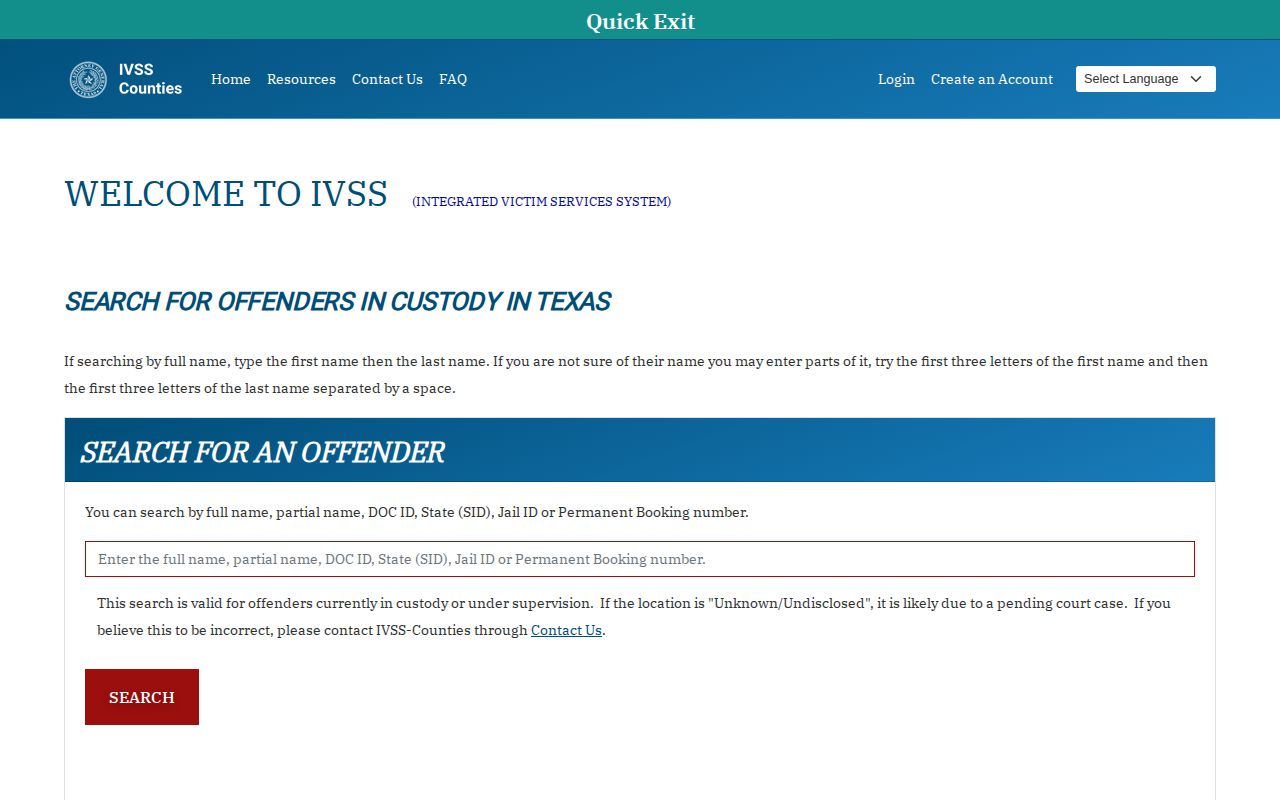
The screen supports a specific-person search and alert registration. It should not be presented as a public Bailey County rolling-release list.
Bailey IVSS Result Fields
IVSS-Counties is built for status checking and notifications, not for certifying a full release file. Fields vary with the reporting agency and record. The Bailey County Sheriff publishes no online sample that would support a more exact local schema. Read only what the matched result actually displays.
| Item | How to use it |
|---|---|
| Name and identifiers | Confirm that the result belongs to the intended person. |
| Reporting agency | Shows which custodian supplied the status and should answer follow-up questions. |
| Location | May identify current custody; unknown or undisclosed is not proof of release. |
| Custody status | Read the exact label and distinguish release, transfer, and continued custody. |
| Case information | May help route the related court inquiry but does not replace the official docket. |
| Notification options | Allow registration for supported call, text, or email alerts. |
The portal says its search covers people currently in custody or under supervision and warns that people no longer in custody may not appear. It reports status changes around the clock, yet it also says the display is not an official record and does not warrant accuracy, timeliness, or completeness. Current IVSS-Counties assistance is available at 866-268-8959.
Register Bailey Release Alerts
Registration can be completed with or without an IVSS-Counties account. An account makes preferences and registration history easier to manage. The portal’s present screens, not an old brochure, control today’s verification process.
- Open the correctly matched custody record after comparing the name, agency, and identifiers.
- Select the notification option for that person and event stream.
- Choose the offered telephone, text, or email method and enter the requested contact details.
- Complete the current contact-verification steps shown by IVSS-Counties.
- Review preferred hours, blackout dates, and the events covered by the registration.
- Keep the jail or booking identifier for later confirmation if the record disappears.
A registered user may remain registered after the person no longer appears and may receive a notice if that person returns to custody. This can preserve ongoing awareness, but it still does not create a certified Bailey County release record. Save an alert’s wording and timestamp, then verify an unclear event with the jail.
Note: Registration supports notice of a reported change; it does not guarantee the exact moment Bailey County completes physical release processing.
Old Bailey VINE PIN Rules
The old Texas VINE telephone workflow used a four-digit personal identification number. A telephone registrant chose the PIN, then entered it followed by the pound key when VINE called. That acknowledgment stopped repeat calls. These instructions help explain old Bailey County materials, but they are historical.
Current IVSS-Counties materials reviewed for Bailey County do not state that a new registration must use the former four-digit PIN. Present instructions focus on account passwords, contact verification, notification preferences, and portal registration. Do not force the legacy procedure onto a modern signup.
This local mismatch is important. Bailey County’s Sheriff page still points readers toward VINE, while the state now directs county users to IVSS-Counties. Existing registrations migrated, but current county participation must still be checked. Use the new portal first, and treat the old phone number and PIN instructions as a record of the prior system.
County Versus TDCJ Alerts
Texas maintains a separate TDCJ IVSS portal for people in state prison or on parole or mandatory supervision. County IVSS-Counties covers participating county jails and court events. TDCJ IVSS covers the post-conviction state system, including prison custody, parole review, release, discharge, and warrant activity under TDCJ supervision.
| System | Correct Bailey County use |
|---|---|
| IVSS-Counties | Bailey County Jail custody and supported county or court events. |
| TDCJ IVSS | State prison, parole, mandatory supervision, discharge, and related warrant events. |
| TDCJ Inmate Information Search | Current TDCJ incarceration only, not an archive of released prisoners. |
| BOP or federal authority | Federal custody, which the Texas county and TDCJ portals do not cover. |
A Bailey County registration should not be assumed to follow a person into TDCJ. When a jail event reports transfer to state custody, search and register in TDCJ IVSS too. TDCJ notifications may include parole eligibility, parole-board action, discharge, prison release, bench-warrant movement, or parole-warrant activity. TDCJ Victim Services lists 800-848-4284 and victim.svc@tdcj.texas.gov.
The official TDCJ current-custody search has a narrower role. It includes only people currently incarcerated in a TDCJ facility, updates on working days, and is at least 24 hours old. A matched result supports current state confinement at the data time. A negative result does not supply an actual release date or reason.
Confirm Bailey IVSS Releases
For a Bailey County jail event, call the Sheriff/general jail line at 806-272-4268 or the Jail Administrator at 806-272-7619. Give the person’s full name, jail identifier if known, and the alert text and time. Ask whether the event was community release or transfer. Then request the existing jail-register entry, booking-out document, and release or transfer record for durable proof.
Texas Local Schedule PS keeps the county jail register permanently and requires it to contain the release or transfer date. That register survives after a temporary IVSS result disappears. A related court file can show the bond, dismissal, judgment, sentence, or order that supplied legal authority, though it may not show the exact time jail processing ended.
If the result indicates TDCJ transfer, continue in TDCJ systems. Federal custody requires BOP or the actual federal authority. The Texas public sex offender registry can confirm post-release information only for a person with a registration duty; it is not a general Bailey County release list. Each system has a defined scope.
Conflicting details should be preserved rather than smoothed over. Record the agency, wording, identifier, and timestamp. Then ask the originating office to resolve the difference. Notification is fast evidence. The government record is the lasting account.
Note: Transfer, release, parole, and discharge describe different events, so the displayed label should remain unchanged until the responsible agency confirms it.
Bailey VINE Match Problems
A failed search can begin with a simple name mismatch. Try the portal’s partial-name method and compare a known identifier before concluding that no record exists. Hyphenated names, spelling differences, common names, or an agency’s delayed transmission can change the result. A person may also be held by a county or authority that is not feeding the selected system.
When several names match, agency and booking identifiers are more useful than age alone. Do not merge two records because their dates or charges look alike. Save the correct jail, SID, DOC, or permanent booking number for the next search and for a later records request.
If a once-visible Bailey County record disappears, the current portal itself warns that people no longer in custody may not remain in results. Contact the Sheriff and ask for the permanent jail-register entry and booking-out record. If the last event was transfer, search the receiving system with the saved identifier. That sequence tests both release and continued custody without turning silence into a fact.