
Bailey County Parole or Probation
Parole begins after a person leaves a Texas Department of Criminal Justice sentence under a decision of the Texas Board of Pardons and Paroles. Mandatory supervision is another supervised release from TDCJ custody. In both cases, the TDCJ Parole Division manages the person in the community. Probation, which Texas agencies call community supervision, comes from a court order. Bailey County Community Supervision and Corrections Department administers adult probation imposed in a local case. Someone can serve probation without ever entering state prison.
The label controls where to verify status. A TDCJ release certificate, Board decision, IVSS status, and parole-office record belong to the state route. A judgment, modification order, revocation order, and CSCD record belong to the local court route. Neither record alone proves the hour someone walked out of Bailey County Jail. That event is documented by the jail register or release paperwork.
| Question | Parole or mandatory supervision | Probation |
|---|---|---|
| Who creates it? | Texas parole law and a Board decision | The sentencing court |
| Who supervises? | TDCJ Parole Division | Bailey County CSCD |
| When does it begin? | After release from TDCJ custody | As directed by the judgment |
| Best verification | IVSS, BPP status, certificate, or parole office | CSCD and the court record |
Verify Bailey County Supervision
Start with the sentence source, not a guess based on the arrest site. A person who bonded out of Bailey County Jail may have no post-release supervision. Someone transferred from that jail to TDCJ was not released to the community at the point of transfer. TDCJ’s online inmate search covers only people currently incarcerated in a TDCJ facility, so a missing former prisoner needs a second check.
- Identify the court, cause number, and whether the sentence was local community supervision or TDCJ confinement.
- For a current TDCJ prisoner, review Parole Review Information in the official inmate detail. Data is updated on working days and is at least 24 hours old.
- For someone who left TDCJ custody, check TDCJ IVSS for parole or mandatory-supervision status.
- Use the Board results route or its status line with a name, TDCJ-CID number, or birth date.
- For probation, contact Bailey County CSCD and compare its response with the filed judgment.
- Request the release certificate or court record when lasting proof is needed.
The Bailey County released inmate search explains how to pair supervision findings with jail, court, and release records. That step matters when the question is whether the person left custody, not merely whether supervision exists.
Bailey County Probation Records
Bailey County has a direct local path. The official county page and statewide CSCD directory identify Director Jessica Montes and the Community Supervision and Corrections Department. The office can address adult probation when disclosure rules allow, while the court judgment establishes what was ordered. A caller should have the person’s full name, case number if known, and the court that imposed supervision.
Bailey County CSCD
Director: Jessica Montes
Address: 300 South First Street, Muleshoe, TX 79347
Phone: 806-272-5147
Fax: 806-272-8908
Official adult probation page
Felony files route through the Bailey County District Clerk and the 287th Judicial District Court. Other case levels may use the County Clerk or Justice of the Peace. The county’s linked official-record portal should not be treated as a complete criminal docket. Ask for the judgment, any order modifying supervision, a revocation order, and a completion record that exists.
Bailey County Parole Office Route
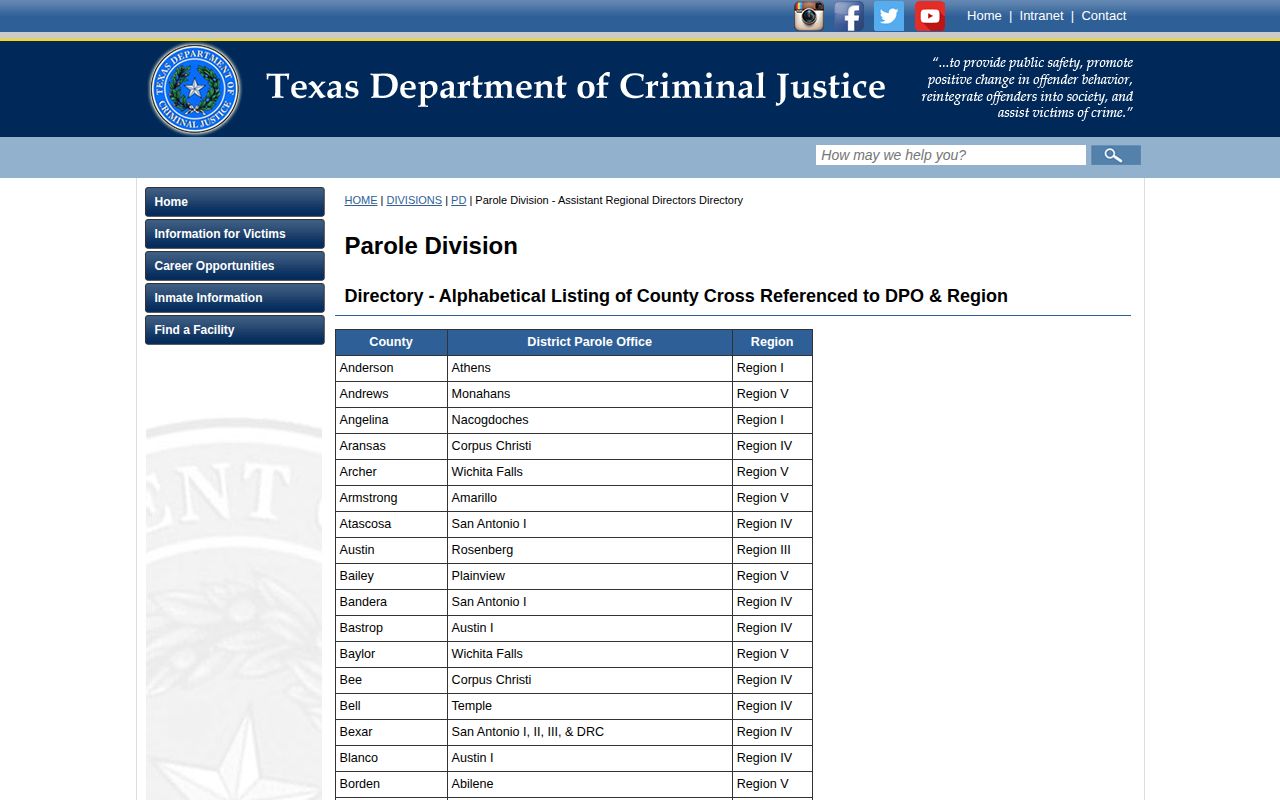
The TDCJ county cross-reference assigns Bailey County to Plainview District Parole Office in Region V. Supervision often follows the approved residence, though, and a person connected to Bailey County may be assigned elsewhere. Confirm the actual office before sending records or traveling.
Plainview DPO, Region V
Address: 1001 North Interstate Highway 27, Suite 232, Plainview, TX 79072
Phone: 806-293-5989
Fax: 806-293-9732
Official Region V directory
The Region V office in Lubbock can help identify an assigned district office. A parole-office contact confirms administration; it does not replace the Board decision or TDCJ release certificate. Those documents answer different questions.
Bailey County Parole Status Online
Texas operates two related notification paths. IVSS-Counties concerns participating county-jail custody. Separate TDCJ IVSS covers state custody, parole, and mandatory supervision. Use the agency and location in a result to avoid mistaking a county transfer for a state-prison release. Bailey County’s Sheriff page still describes legacy SAVNS/VINE, while Texas moved county notifications to IVSS-Counties in 2025.
For parole, TDCJ IVSS can bridge the gap after a current-prison profile disappears. Registration can provide confidential status alerts, but an alert is not a discharge record. Preserve the exact event text. “Transfer,” “parole release,” “mandatory supervision,” and “discharge” mean different things.
The official TDCJ county assignment page identifies Bailey County’s office route.
Bailey County Parole Decisions
Before release, the Board of Pardons and Paroles uses a file review rather than a formal public offender hearing. A three-member panel reviews the case and records votes. The Board’s public meeting minutes concern agency governance and must not be described as a calendar of individual parole hearings. For one person, use the Parole Review Information link in the current TDCJ detail, the official results page, or the status telephone line.
A parole review status is not the same as a decision, and a decision is not the same as physical release. Approval codes can require a program, approved plan, or other step before release processing. Denial codes may set a next review or require service of more time. TDCJ Review and Release Processing then checks residence, disciplinary history, special conditions, programs, and detainers before issuing the certificate. Preserve the code and date exactly rather than translating approval into an assumed release day.
The public inmate detail is updated on working days and is at least 24 hours old. Once a person leaves current TDCJ confinement, that profile may disappear. The Board result route, TDCJ IVSS, and a records request then become more useful than repeated name searches.
Bailey County Supervision Record Limits
Supervision records do not all have the same public status. Government Code Chapter 508 protects some parole information, and agencies may redact confidential details. County probation files can also contain information that is not open in full. A narrow request for the judgment, release certificate, public status, and discharge record is more useful than asking for an entire case file without limits.
Identity checks matter. Bailey County is small, but common names and date errors can still produce a false match. Use the TDCJ or SID number for state records and the cause number for court records when available. Note the office, source, and observation date. If two sources differ, ask the originating agency to explain its own record rather than deciding that the newest-looking screen must be right.
Bailey County Release and Supervision
Bailey County Jail can release a person on bond, after time served, following dismissal, under another court order, or by transfer to another authority. None of those labels automatically means parole or probation. Bond release usually leaves the criminal case pending. A dismissal may end a charge without creating supervision. Transfer means custody continued elsewhere.
To build a sound timeline, obtain the jail’s release or transfer entry first. Next, read the court judgment or order. Only then use Bailey County CSCD or TDCJ Parole Division to verify a supervision status. This order prevents a common error: treating any person who left the jail as a parolee. It also prevents a probation record from being used as proof of the exact jail exit date.
Bailey County Supervision Conditions
Conditions are rules attached to supervision. They may concern reporting, approved residence, travel, treatment, programs, or other case-specific duties. The judgment and supervision papers control. A public summary cannot establish an individual condition.
A violation is an alleged failure to follow a condition. An absconder is generally a person alleged to have stopped reporting or left supervision without authorization. Neither label should be applied from rumor or an empty search result. Verify a warrant through the issuing court or agency and ask the supervising office what public status it can disclose. A violation allegation may lead to review or revocation, but it does not prove a new release or final outcome.
Bailey County Supervision Discharge
Release and discharge mark different stages. A parolee has left incarceration but remains under TDCJ authority for the balance of the sentence. Mandatory supervision also places the person in the community under conditions. Probation remains a court status administered by CSCD. Final discharge or successful completion ends that authority unless another case or hold applies.
For a state sentence, request the release certificate, supervision history, and discharge date through the TDCJ Public Information Act process. For probation, ask Bailey County CSCD and the proper clerk for existing completion, modification, or revocation records. Government Code Chapter 508 restricts some parole information, so protected material may be withheld or redacted.
TDCJ requests can identify the person by full name and TDCJ or SID number. If an identifier is unknown, include the exact birth date or enough age and conviction-county information to prevent a mistaken match. Ask for existing documents rather than an agency-created explanation. Classification and Records handles inmate-time and release questions at 936-437-6231, while the public-record route handles copies of releasable records.
Probation completion should be checked against the local judgment because supervision can be modified, revoked, extended, or completed through filed court action. A jail record may show when physical custody ended, but it does not replace the later completion record. In the same way, a release certificate can show the start of parole without proving final discharge. Keeping each date tied to its source gives a clear timeline: custody, supervised release, and the end of supervision.